


Updated October 2026: This article has been corrected. Current WebODM runs ODX, a separate engine forked from ODM, so the processing engine did change, and WebODM Lightning runs its own engine, LGT. We also corrected the Docker image names, licence details, and the history of CloudODX, and removed a section speculating about why the two projects split. No primary source gives a reason.
On April 6, 2026, WebODM split from OpenDroneMap. WebODM’s documentation is blunt about it: “WebODM is no longer affiliated or connected to OpenDroneMap. They are two separate projects.” WebODM now has its own GitHub organization, led by its lead maintainer, Piero Toffanin.
If you process drone imagery with WebODM, this affects where you download the software, which Docker images you pull, where you go for documentation, and which processing engine runs your jobs. It doesn’t affect your existing projects or your licence. The software is still free. The outputs are still yours.
Here’s what happened and what you need to do about it.

What Happened
The split took effect on April 6, 2026. WebODM 3.2.0 followed on April 9 (UTC). Its release notes open with “We decoupled from OpenDroneMap!” and list updated organization URLs and policy updates.
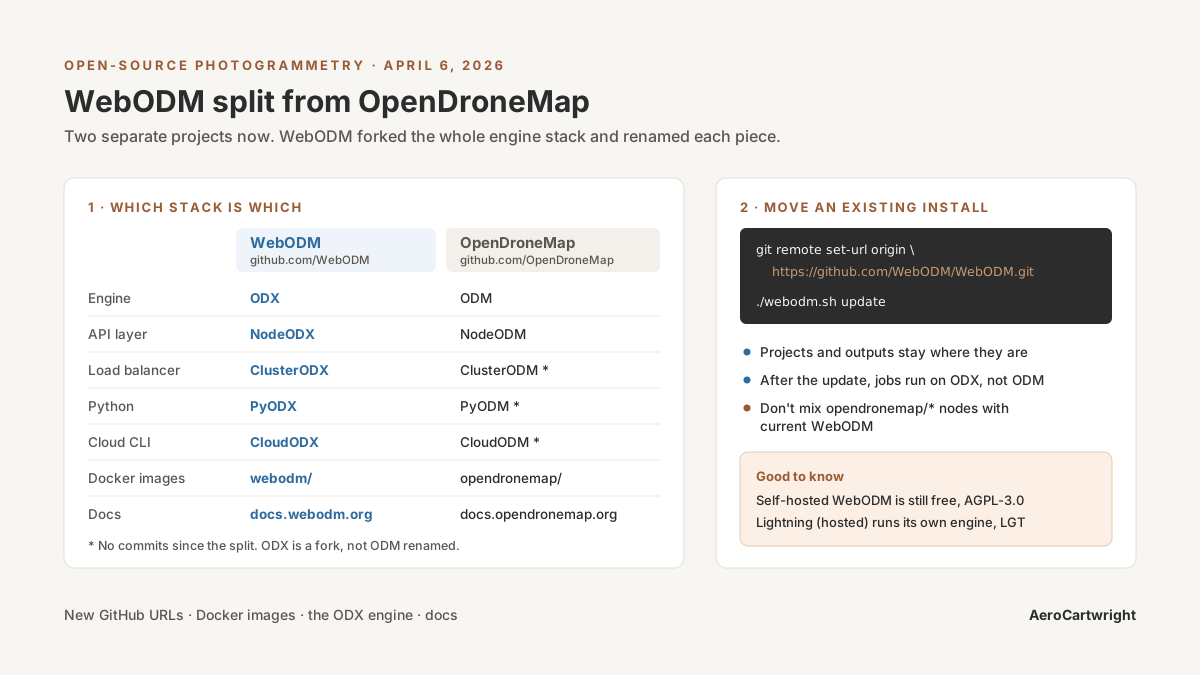
The new home for WebODM: github.com/WebODM. It isn’t just the web interface. The WebODM project forked the engine stack and gave each piece a new name: ODM became ODX, NodeODM became NodeODX, ClusterODM became ClusterODX, PyODM became PyODX, and CloudODM became CloudODX. The organization hosts WebODM, ODX (the processing engine), NodeODX (the API layer), ClusterODX (the load balancer), CloudODX (a command-line tool for processing imagery in the cloud via NodeODX), PyODX, and its own copies of supporting libraries such as OpenSfM and OpenMVS.
ODX is not ODM under a new name. WebODM describes it as “forked from, faster than ODM,” and the two engines are now developed separately. New to how these pieces fit together? The ODM vs ODX fork explainer breaks down what changed and which stack you’re actually running.
OpenDroneMap continues as a separate project at github.com/OpenDroneMap. It still develops ODM and NodeODM. Its ClusterODM, PyODM, and CloudODM repositories remain there but have had no commits since the split.
OpenDroneMap also sells installers for forks of WebODM, called “WebUI” or “OpenDroneMap Desktop.” As WebODM’s own site puts it, those are not WebODM. If you want WebODM, download it from webodm.org.
Self-hosted WebODM is still free and open source. WebODM, ODX, NodeODX, and ClusterODX are AGPL-3.0. PyODX is BSD-3-Clause and CloudODX is GPL-3.0. WebODM isn’t open-core or dual-licensed.
What Changed for Users
If you’re installing WebODM for the first time
On Windows or macOS, the easiest path is the free installer from webodm.org. As of October 2026 that’s version 3.3.1 on Windows and 3.3.0 on macOS.
On Linux, clone from the new repository and start it with Docker:
git clone https://github.com/WebODM/WebODM --config core.autocrlf=input --depth 1
cd WebODM
./webodm.sh start
Docker images now use the webodm/ namespace: webodm/webodm_webapp, webodm/nodeodx, webodm/odx, and webodm/clusterodx. A default install runs the web app, its database and Redis, plus webodm/nodeodx for processing. For GPU processing, ./webodm.sh start --gpu uses webodm/nodeodx:gpu. The old opendronemap/ images still exist but don’t receive WebODM’s updates.
Documentation: docs.webodm.org. The docs at docs.opendronemap.org cover OpenDroneMap’s ODM engine, not WebODM’s ODX.
If you have an existing WebODM installation
Your current installation works. Nothing breaks. To track WebODM going forward, point your install at the new repository and update:
git remote set-url origin https://github.com/WebODM/WebODM.git
./webodm.sh update
Or clone fresh from the new URL. Once you update, your processing runs on ODX instead of ODM.
If you use WebODM Lightning
WebODM Lightning at webodm.net is operated by UAV4GEO, the company of WebODM’s lead maintainer, not by OpenDroneMap. It processes on LGT, its own engine, which is only available on Lightning. You can also add Lightning as a processing node inside a self-hosted WebODM.
If you hit the NodeODM or NodeODX API directly
Docker image names changed. Current WebODM uses webodm/nodeodx. Integrations pointing to opendronemap/nodeodm still pull OpenDroneMap’s image, which runs ODM, not ODX. Pick one stack and update your Docker Compose files or orchestration configs accordingly. Don’t mix opendronemap/* nodes with current WebODM, which only guarantees compatibility with NodeODX.
If you script against the API with PyODM, WebODM’s migration guide says to switch to PyODX: change from pyodm to from pyodx, and rename OdmError to GenericError.
The Engine, the Licence, and Your Accuracy
The processing engine changed. Current WebODM runs ODX, an ODM fork that WebODM describes as faster than ODM. OpenDroneMap continues developing ODM separately. Don’t assume the two engines produce identical outputs.
The licence didn’t. WebODM, ODX, NodeODX, and ClusterODX are AGPL-3.0, like their ODM-era predecessors. Your maps, models, and point clouds are yours. For most operators processing their own imagery, the licence asks nothing of you. It matters if you distribute WebODM, or modify it and let others use it over a network: then you must make the corresponding source available.
Processing parameters. ODX was forked from ODM, so it started from ODM’s processing options: feature-quality, pc-quality, mesh-size, SMRF values, --fast-orthophoto, and the rest. ODX is developed separately, though, so check docs.webodm.org for the current list rather than assuming nothing changed.
Accuracy. Both engines build on OpenSfM, OpenMVS, and PDAL, but ODX is developed separately. Don’t assume old accuracy benchmarks carry over unchanged. Check your own results with ODX’s Quality Report: give checkpoints a CHK- label prefix in your GCP file, and the report lists each checkpoint’s X, Y, and Z error alongside reprojection error, overlap, and camera calibration.
What to Watch Going Forward
ODX and ODM share ancestry. They’re developed separately now.
Feature development. NodeODX is a REST API for multiple photogrammetry engines: ODX, MicMac, and LGT (LGT is only available on Lightning). WebODM 3.2.0, the first release after the split, added NVIDIA RTX 50 Series support and checkpoints.
ODM engine maintenance. OpenDroneMap continues developing ODM and NodeODM at github.com/OpenDroneMap. No public source describes plans to share fixes between the two projects, so don’t count on improvements crossing over.
Community. WebODM has its own Discord, linked from webodm.org, separate from OpenDroneMap’s Discourse forum at community.opendronemap.org. If you rely on community support, ask WebODM questions in WebODM’s channel.
Long-term stability. Forks sometimes drive faster development. Sometimes they split the contributor pool. It’s too early to call. For WebODM users, the practical answer is simple: stay on the WebODM stack, because that’s what WebODM supports.
The Practical Bottom Line
If you’re setting up a new WebODM installation today: use the installer from webodm.org on Windows or macOS, or github.com/WebODM/WebODM on Linux. That’s WebODM’s own repository, and it ships with ODX.
If you have an existing installation that works: no urgency to change. Update your remote when convenient.
If you’re evaluating WebODM against commercial alternatives: self-hosted WebODM is still free. It still processes full orthomosaics, point clouds, DSMs, and 3D textured models, and its ODX engine produces a Quality Report with per-checkpoint errors. What changed is that WebODM is now a separate project and runs the ODX engine.
The address changed, and so did the engine: ODM to ODX. Update your bookmarks and carry on.